Why Federated Learning Matters for Distributed Systems: Benefits, Challenges & Real-World Impact
Introduction
Distributed systems power everything from global cloud platforms to edge-based IoT networks. As these systems generate and rely on massive amounts of data, traditional centralized machine learning struggles with privacy concerns, bandwidth limitations, and scalability barriers. Federated learning solves these issues by training models across devices without moving raw data, making it a transformative approach for modern computing environments.
What Is Federated Learning?
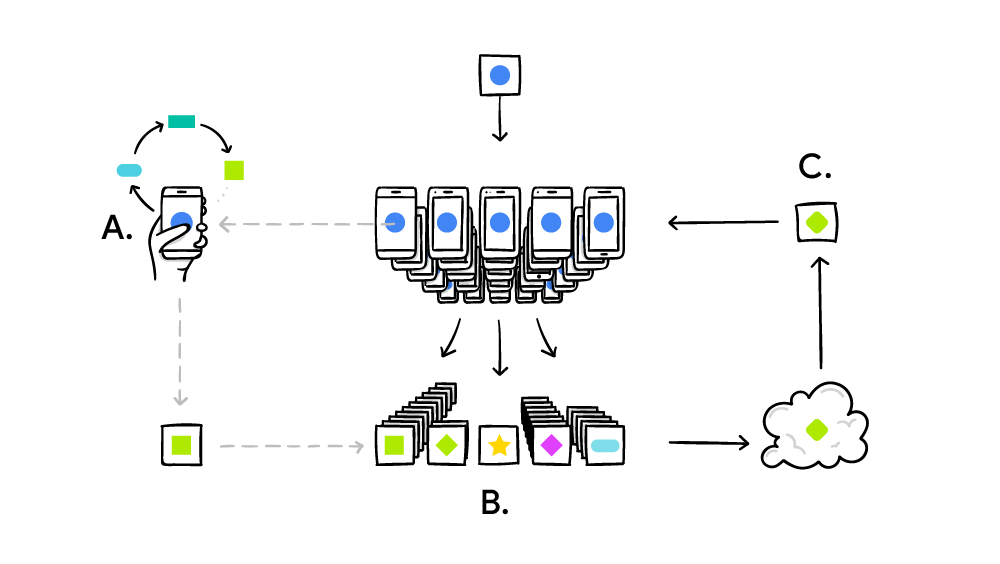
Federated learning is a decentralized approach to machine learning where the training process occurs locally on distributed devices instead of sending all data to a central server. Only model updates (such as gradients) are shared, and they are securely aggregated to improve a global model.
Key Characteristics
-
Data remains local, enhancing privacy
-
Model updates are shared, not raw data
-
Works across large networks of devices
-
Optimizes bandwidth and energy consumption
Why Federated Learning Matters for Distributed Systems
1. Strengthened Data Privacy and Security
In distributed systems, moving sensitive data to centralized servers introduces security risks. Federated learning avoids this by keeping data on the user’s device or node. This minimizes exposure, lowers the risk of breaches, and supports strong data governance.
Benefits
-
Reduces data leakage risks
-
Enhances user trust
-
Supports secure distributed environments
2. Lower Network Bandwidth Usage
Distributed systems often operate across constrained networks, especially in IoT and mobile environments. Federated learning transmits lightweight model updates rather than large datasets, reducing network load significantly.
Benefits
-
More efficient bandwidth consumption
-
Lower operational costs
-
Better performance on limited or unstable connections
3. Scalable Learning Across Millions of Nodes
Traditional centralized learning becomes inefficient as the size of the network grows. Federated learning excels because training occurs in parallel across nodes, making it inherently scalable.
Impacts
-
Supports large IoT ecosystems
-
Enables continuous learning on expanding networks
-
Handles device mobility and dynamic participation
4. On-Device, Real-Time Intelligence
Many distributed systems require immediate decisions—such as anomaly detection in sensors or personalized experiences on smartphones. Federated learning empowers devices to learn locally, improving responsiveness and reducing latency.
Advantages
-
Faster decision-making
-
Reduced dependence on cloud connectivity
-
Improved user experiences through personalization
5. Better Compliance With Global Data Regulations
Regulations like GDPR and HIPAA restrict how data can be stored and transferred. Federated learning aligns naturally with these rules because data stays at the source, simplifying compliance.
Ideal For
-
Healthcare systems
-
Financial networks
-
Smart city platforms
-
Telecommunications providers
6. Increased Fault Tolerance and System Resilience
Distributed systems benefit from architectures that continue functioning despite node failures. Since federated learning does not depend heavily on any single node, the training process remains stable even if some devices disconnect.
Strengths
-
Resilient learning process
-
Reduced single-point-of-failure risk
-
Adaptive model training despite intermittent nodes
Use Cases of Federated Learning in Distributed Systems
IoT and Edge Networks
Smart home devices, wearables, and industrial sensors can collaboratively train models without exposing sensitive usage data.
Healthcare Systems
Hospitals and clinics can build diagnostic models without sharing private patient records.
Telecommunications
Mobile networks leverage federated learning to optimize signal routing, resource allocation, and user experience.
Autonomous Vehicles
Vehicles learn collectively from road conditions without uploading driving footage to central servers.
Retail and E-Commerce
Customer behavior models can be trained locally on user devices, improving personalization without risking privacy.
Conclusion
Federated learning reshapes how distributed systems handle intelligence, making them more private, scalable, efficient, and resilient. As organizations adopt edge computing, IoT networks, and decentralized architectures, federated learning becomes a foundational technology empowering secure and adaptive data-driven solutions.
Frequently Asked Questions (FAQ)
1. How does federated learning differ from traditional distributed learning?
Federated learning avoids sharing raw data and focuses on aggregating model updates, whereas traditional distributed learning often depends on centralized data storage.
2. What role does the central server play in federated learning?
It coordinates updates and aggregates model parameters but never accesses the original data from devices.
3. Can federated learning work in low-connectivity environments?
Yes. Since updates are small and training happens locally, federated learning is effective even with intermittent connectivity.
4. Is federated learning suitable for large-scale IoT networks?
Absolutely. Its decentralized nature supports millions of devices with minimal communication overhead.
5. What security techniques enhance federated learning?
Methods such as differential privacy, secure aggregation, and encrypted computation strengthen protection.
6. Are there performance trade-offs in federated learning?
Yes. Varied device capabilities, non-uniform data quality, and update delays can affect training efficiency.
7. Which industries are adopting federated learning the fastest?
Healthcare, finance, telecommunications, automotive, and consumer electronics are leading adopters.